Intervenors’ Opposition to Dismissal
The Proposed Settlement (Dkt. No. 139-1) reached between the Plaintiffs and the University Defendants, if allowed to proceed, would only lead to a deeper societal, political, and constitutional crisis. It seeks to make UC-Berkeley, the home of the Free Speech Movement, the nation’s premier testing ground for destroying free speech, at the very moment free discussion and debate of U.S. governmental policy is urgently needed to protect American democracy and prevent world war. By branding legitimate criticism of Israel as “antisemitic,” it imposes a chilling effect on—and empowers a labyrinth of committees to suppress—student activism criticizing the actions of the U.S. and Israeli governments. President Trump’s claim that Israel must be “defended” at all costs is now being used to justify bombing Iran “back to the Stone Ages” and bring humanity closer to the precipice of world war.
This Court should deny the Motion for Dismissal because the Proposed Settlement proves that this Court was correct when it granted intervention to the Student Intervenors, when it asserted that the Intervenors “plausibly allege interests that might be affected by the litigation, and may have defenses that UC Berkeley may not raise.” (Dkt. No. 84, at 2) The Court asserted that this case should not resolve without the Intervenors’ interests and their arguments on the merits of Plaintiffs’ case being considered. The Court understood that the true defendants the Plaintiffs seek to restrain are the students and campus community members whose speech the Proposed Settlement brands as “antisemitic.” Yet the other parties attempt to circumvent the substance of this Order by concluding the Proposed Settlement secretly and trying to present a fait accompli to the Intervenors and this Court. The Court should not reverse course and should reassert its Order and ensure that the Intervenors are heard in this case. The Court should deny dismissal and allow the Intervenors to continue with discovery and submit a motion for summary judgment.
The University Defendants have concluded a Proposed Settlement that does not protect First Amendment rights, and they refuse to make the case that the Intervenors will: that the Plaintiffs fail to prove that the incidents of pro-Palestine protest they cite at UC-Berkeley (UCB) were “antisemitic,” and that this Court should follow the law as articulated by the First Circuit when it dismissed a nearly-identical lawsuit brought against MIT. Stand With Us v. MIT, 158 F.4th 1 (1st Cir. 2025). (Infra at 5.) In fact, the First Circuit specifically held that certain forms of speech criticizing Israel prohibited by the IHRA are protected First Amendment speech. Id. at 16.
The Plaintiffs’ central claim, that Zionism is “an integral part of Jewish identity,” (Complaint at ❡ 8) cannot withstand summary judgment, when the Intervenors can present evidence that many Orthodox Jews believe that establishing a secular Jewish state is sacrilegious. (See EXHIBIT 1, preliminary statement by Rabbi Yisroel Dovid Weiss of Neturei Karta, CITE REPORT) Orthodox Jews have engaged in militant protest against Israeli militarism.[1]
Further, the Intervenors—who include Muslim and Jewish students, including Shmuel Barkan, a Jewish dual citizen of U.S. and Israel—are the only parties who reject the Proposed Settlement’s false counterposition between the right to self-determination of Palestinians and the right of Jews to remain in Palestine and have a state of their own, side by side with a Palestinian state. The Proposed Settlement adopts the International Holocaust Remembrance Alliance (IHRA) definition of “antisemitism,” which states that calling the existence of the State of Israel “racist” is “antisemitic” and denies Jews their right to self-determination, when it does not. In fact, there is a growing consensus—including among scholars such as Ilan Pappe who are willing to serve as expert witnesses for the Intervenors—that Israel continuing its present policies of ethnic cleansing, genocide, and colonialism against its Muslim and Arab neighbors threatens the future of Israel in the Middle East and can lead to Israel’s “collapse.”[2] With this understanding, thousands of young Israelis have started to defy wartime stay-at-home orders and taken to the streets against their government’s war with Iran.[3]
The Proposed Settlement does not protect Jews at UCB from antisemitism. In fact, it does the opposite. Kenneth Stern, the author of the IHRA definition of antisemitism that the Proposed Settlement adopts, opposes its use as a “hate speech code” on university campuses and has stated that using it as such would actually not protect Jewish students:
“There was never any idea that this would be used as a de facto hate speech code on campus… to curtail speech on a campus, in particular, is something that was never contemplated… Since 2010, people on the Jewish right have been trying to take the definition, marry it with the powers under Title VI and use it as a way to try and suppress pro-Palestinian speech on campus… As much as I might agree with some of the criticisms of that speech, there’s a way you deal with that on a campus: You think critically about it and push back…
I don’t think it protects Jewish students from harassment. A lot of this comes to whether anti-Zionism is anti-Semitism or not. It’s part of this internal debate in the Jewish community about who’s inside the tent and who’s outside the tent. I don’t like government putting its thumb on the scales inside of a debate inside the Jewish community.”
Excerpt from “The scholar who wrote the definition of anti-Semitism says it’s been subverted,” The Times of Israel (Jan. 9, 2020) (emphasis added)[4]
The Proposed Settlement associates Judaism with the extreme right-wing Zionism of the State of Israel and sets up Jews to be targets of the present rise in antisemitism in the United States. For the first time in U.S. history, more Americans sympathize with the Palestinians than with Israelis.[5] This coincides with an alarming rise in antisemitism internationally, expressed most clearly in the U.S. among elements of the MAGA movement who have broken with Trump on Israel.
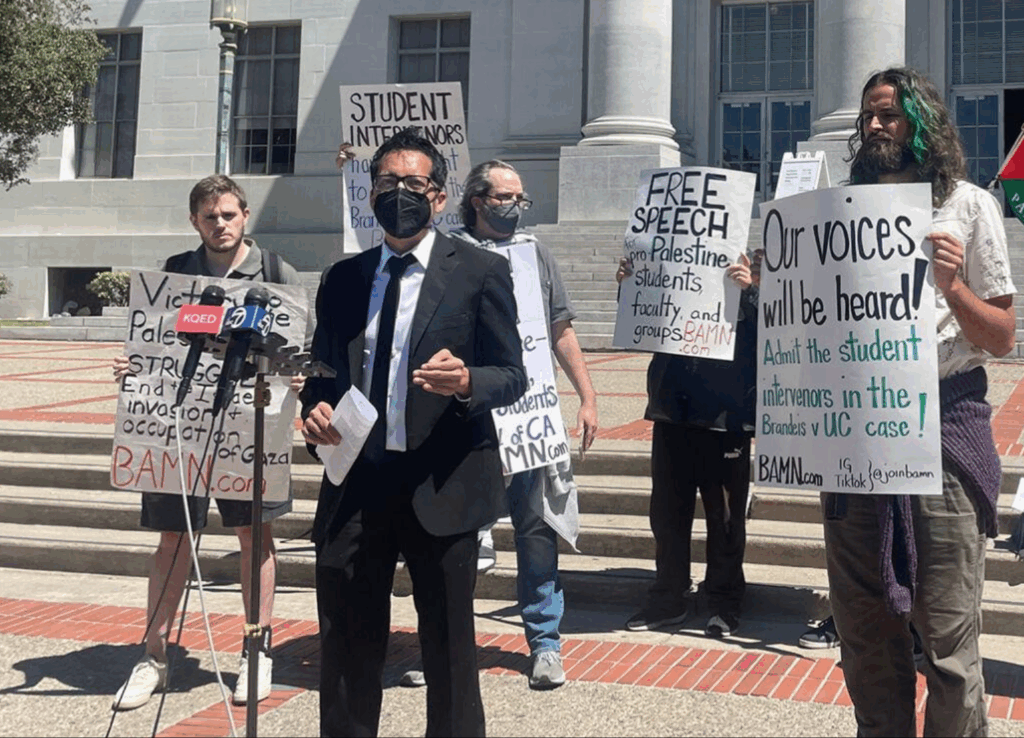
The second basis for denying the Motion is that the Court should grant the Intervenors’ re-raised motion for intervention as of right. The Intervenors include Berkeley Law Jews for Palestine, UCB’s Muslim Student Association, UCB BAMN (Coalition to Defend Affirmative Action, Integration and Immigrant RIghts and Fight for Equality By Any Means Necessary), and Dr. Benjamin Lynch who indisputably have affiliations with UC-Berkeley. (The stated lack of which was the basis for the Court previously denying intervention as of right.)
Once the First Circuit ruled in Stand With Us and the intervenors cross-examined and posed questions to an individual Student Plaintiff that she could not answer, it became clear that the Defendants’ case was eminently winnable. It was at this moment that the University hurried to settle with the Plaintiffs on terms amenable to the Plaintiffs. (This is described in detail in the Intervenors’ renewed motion for leave to file a motion for reconsideration of their status as intervenors, submitted in concurrence with this brief.) By doing so, the University forfeited any claim it could make that it adequately represents the interests of pro-Palestine University students, faculty, and staff.
I. This Court should not reverse course and should not approve a Proposed Settlement that ignores the rights and arguments of the Intervenors this Court said must be considered.
The Motion for Dismissal’s argument boils down to (1) claiming that the policies set by the University of California are a private concern between the Plaintiffs and the University administration without implications for free speech at a public university, and (2) stating that the pro-Palestine and anti-war students represented by the Intervenors have no rights the University need respect. When this Court granted intervention to the Student Intervenors, it correctly thought otherwise. The Court understood that a resolution of this case without the involvement of the Intervenors will lead only to further conflict and litigation.
There is no need to open the door for the societal and legal conflict that will inevitably occur as a result of the Proposed Settlement; this Court can ensure that the crucial, historic questions at stake in this case are resolved now. The Trump administration is arresting and threatening to deport activists like Mahmoud Khalil, by expansively stating that criticism of Israel is “antisemitic.” His administration is attempting to blackmail universities to attack free speech and academic freedom: in 2025, the Department of Justice demanded UCLA give $1.2 billion for allegedly fostering “antisemitism” on the campus, and has now filed a federal lawsuit against the University.[6] The Plaintiffs’ core contention—that criticism of Israel is “antisemitic”—poses a vital, pressing constitutional question for the future of democracy that must be resolved now.
The First Circuit Court of Appeals shows the way. On October 21, 2025, the First Circuit upheld the dismissal of a nearly-identical lawsuit brought against MIT. It held that speech on the conflict in Gaza was on “a matter of public concern” and was protected under the First Amendment. Id. at 10. It specifically held that certain forms of speech prohibited by the IHRA and the Proposed Settlement as “antisemitic” are protected speech under the First Amendment. The First Circuit held:
To support their claim of antisemitism, plaintiffs point to the protestors’ opposition to Zionism, which they argue is inherently antisemitic. “Zionism,” plaintiffs explain, “is the belief that Jews have the right to self-determination in their ancestral homeland of Israel.” Plaintiffs argue that because “most Jews” see Zionism as “a key component of their Jewish ethnic and ancestral identity,” “ ‘anti-Zionism’ is … antisemitism.” In plaintiffs’ view, speech is anti-Zionist, and therefore antisemitic, if it “oppose[s] Jewish self-determination in the State of Israel”; if it “claim[s] that the existence of a State of Israel is a racist endeavor”; if it “requir[es] of [Israel] a behavior not expected or demanded of any other democratic nation”; and if it “draw[s] comparisons of contemporary Israeli policy to that of the Nazis.”[7] Under this framework, plaintiffs also treat as antisemitic any criticism of Israel’s conduct in Gaza, any suggestion that violence by Palestinians can be understood as resistance to colonial rule and Israeli expansion, and any implication that Palestinians should govern—or even simply be “free”—in all of Palestine (i.e., “from the river to the sea”).
Plaintiffs are entitled to their own interpretive lens equating anti-Zionism (as they define it) and antisemitism. But it is another matter altogether to insist that others must be bound by plaintiffs’ view… Nor does a review of the academic literature point to any consensus that criticism of Zionism is antisemitic…
This absence of consensus reflects ongoing debate as to the relationship between anti-Zionism and antisemitism—debate that our constitutional scheme resolves through discourse, not judicial fiat…
Stand With US Ctr. for Legal Just. v. Massachusetts Inst. of Tech., 158 F.4th 1, 16-17 (1st Cir. 2025) (emphasis added).
The fact that the governmental action in this case comes from UC-Berkeley and not from a court makes it no less offensive to the Constitution, and does not lessen the Court’s duty to enforce the Constitution.
When the Plaintiffs filed their suit, they submitted to the jurisdiction of this Court and raised the pressing legal question: when is speech criticizing the State of Israel antisemitic? The MIT decision occurred in the context of discovery not having begun yet. The Intervenors present the possibility of this case being the first and only one in the country where a factual record is developed that actually tests the Plaintiffs’ claim on the merits. Simply because the First Circuit ruled against the Plaintiffs’ view should not be the occasion for them to hit the eject button after having wasted this Court’s time. If the courts do not resolve this question now, it will be resolved later through political crisis and social unrest.
This Court granted intervention in order to have a resolution of the substantive issues in this case that actually included the students who are affected. This Court should reject the other parties’ invitation to ignore the Intervenors and the Constitution. There can be no “settlement” of the students’ rights without the students being heard.
II. The Proposed Settlement commits the University to enforcing the IHRA definition of “antisemitism,” imposing a viewpoint-based restriction on core political speech.
Viewpoint-based restrictions on speech are “egregious” restrictions on speech that the Constitution does not abide. The Supreme Court held:
When the government targets not subject matter, but particular views taken by speakers on a subject, the violation of the First Amendment is all the more blatant… Viewpoint discrimination is thus an egregious form of content discrimination. The government must abstain from regulating speech when the specific motivating ideology or the opinion or perspective of the speaker is the rationale for the restriction.
Rosenberger v. Rector & Visitors of Univ. of Virginia, 515 U.S. 819, 829 (1995) (citations omitted, emphasis added)
At UC-Berkeley under the Proposed Settlement, a student speech on Sproul Plaza defending acts by Israel found by the United Nations and numerous scholars to be war crimes is allowed, but a speech denouncing those same acts for resembling those committed by the Nazis is prohibited. A scholarly article claiming that Israel is the “only democracy” in the Middle East is allowed, but one that criticizes the State of Israel as a racist endeavor by citing its past and current acts of ethnic cleansing is prohibited.
This Court itself acknowledged that criticism of the State of Israel is core political speech and that disagreement over the nature of the State of Israel and whether it should exist is legitimate political discourse, and it acknowledged that there is disagreement among Jews on this question. At the February 29, 2024 case management conference, the Court stated to Plaintiffs’ counsel:
THE COURT: Let’s just say Zionism is a purely political point of view. Purely political. Okay? There are some Jews who are Zionists. There are some Jews who are anti-Zionists. There are some Christians who are Zionists–which is true–and there are some Christians who are not Zionists. In other words, it’s just a purely non-religion-based, non-ethnicity-based political view…
Dkt. No. 56, at 13.
MR. CARROLL [Plaintiffs’ counsel]: [A]nti-Zionism is effectively anti-Semitism, and certainly, you know, our clients feel strongly that that is the case…
THE COURT: … I mean, I literally drove by a synagogue in Oakland on the way to the dentist a couple of weeks ago which had a banner that said, “We are an anti-Zionist congregation.”
So what are you going to do about the fact that there’s no Jewish faith? Like a Catholic church, there’s no unified Jewish faith, and there are a lot of people who are ethnically and culturally Jewish who don’t practice any religious beliefs and the community is riven between Zionists and anti-Zionists. I love Netanyahu. I hate Netanyahu. I think Israel should exist. I think Israel should be abolished. This is all–how are you going to prove any of this? How are you going to prove that all–that Zionism and Judaism are equivalents?
MR. CARROLL: And so I want to distinguish between what we think are political viewpoints, for example, you know, policies of the Israeli government, things of that nature, as opposed to Zionism, which I don’t think is necessarily coextensive.
THE COURT: … [T]his goes back to my days when I was a graduate student doing Modern European History. My understanding is that Zionism was born in Vienna in the early part of the Twentieth Century as a political movement. That was the first avowedly or self-consciously Zionist movement, Theodor Herzl… [T]hat’s my recollection. So this isn’t something that goes back to the Old Testament is my point.
Dkt. No. 56, at 14-15 (emphasis added).
However, the Proposed Settlement will prohibit speech defined as “antisemitic” under the IHRA definition and its “contemporary examples of antisemitism” that the Court acknowledged were “purely political” positions and part of legitimate discourse. (See Proposed Settlement Dkt. No. 139-1, ❡❡ 14a, 14b, 15C, 18, 18d, 19b). The IHRA states among its “contemporary examples” of “antisemitism”:
- Denying the Jewish people their right to self-determination, e.g., by claiming that the existence of a State of Israel is a racist endeavor.
- Drawing comparisons of contemporary Israeli policy to that of the Nazis.
EXHIBIT 2, IHRA Definition of Antisemitism.[8]
The Proposed Settlement then creates numerous mechanisms to police student speech, faculty speech and research, and academic courses in violation of academic freedom.
Two internationally-renowned Israeli Jewish scholars who criticize Israel and who have agreed to be expert witnesses for the intervenors, Ilan Pappé and Omer Bartov, would be unable to present their research at UC-Berkeley, and their views could not be freely discussed.
Ilan Pappé is an Israeli historian and professor at the University of Exeter who has published numerous books on the Israel-Palestine conflict. He has called Israel a settler colonial state and an apartheid state. Professor Pappe has provided a statement to this Court explicating the danger to academic freedom and free speech that the Proposed Settlement poses:
The clear association in the IHRA definition of antisemitism with reference to Zionism as settler colonialism and to Israel as an apartheid state renders most of the professional and academic consensual research on Zionism and Israel as antisemitic. That would be equivalent to accusing Western academia, at the heydays of Apartheid South Africa, of framing the regime as racist, as being an anti-Christian position.
Defining Zionism as settler colonialism, as well as pointing to the apartheid nature of Israel, is not a matter of political opinion anymore. This is the outcome of both academic research and inquiries by human rights organisations such as Amnesty International, Human Rights Watch and the Israeli human rights organisation B’Tselem. This research, which examined in detail the Israeli policies in the Gaza Strip, the West Bank and inside Israel, should at least be respected under the basic principles of freedom of research and speech, even though it is difficult for political reasons to appreciate the professional acumen and validity of their findings.
As someone whose books on Israeli apartheid and racism were published by, among other[s] Cambridge University Press, Yale University Press and California University Press, according to this definition, these works will be defined as antisemitic under the IHRA, and I will be unable to meet peers and students in UC-Berkeley, for instance, to discuss my scholarly work.
Given the current Israel policy is accentuating the apartheid nature of Israel and leads to intensification of Israeli war crimes, committed both by the army in the Gaza Strip and the settlers in the West Bank, the IHRA would rightly be seen not as means of confronting antisemitism in American campuses but rather as an attempt to justify violations of international law, war crimes and crime against humanity, against which we would expect and demand from our academia to cry out against and fulfil its moral duty in our society.
EXHIBIT 3, statement by Ilan Pappé.
Omer Bartov is an Israeli-American historian who focuses on the Holocaust and on genocide. His op-ed characterizing Israel as carrying out a genocide, “I’m a Genocide Scholar. I Know It When I See It.” ran in the New York Times on July 15, 2025.[9] His op-ed was cited by the First Circuit in its Stand With Us decision. Stand With Us, 158 F.4th at 19. He has extensively researched the Holocaust, publishing many books on the German Army and the development of genocidal attitudes among its soldiers. He cited his scholarship in another New York Times op-ed that he penned, drawing parallels between the young people who encountered in the Israel Defense Forces[10] and the attitudes he studied in the Nazi army. His scholarship, and free discussion of his research, would also be prohibited at UC-Berkeley under the Proposed Settlement.
CONCLUSION
This Court should not reverse course and should maintain its position that this case should not be resolved without the Intervenors’ interests and arguments being heard. It should meet its duty to enforce the Constitution and ensure that Plaintiffs’ claims are tested on the merits, to settle a pressing legal question facing American higher education and democracy. The Motion for Dismissal should be denied.
By the Defendant-Intervenors’ Attorneys,
UNITED FOR EQUALITY AND AFFIRMATIVE ACTION LEGAL DEFENSE FUND (UEAALDF)
BY: /s/ Shanta Driver
Date: April 6, 2026
[1] “Thousands of Haredi men blocked traffic near Tel Aviv and in Jerusalem for about four hours on Thursday as they heeded their rabbis’ call to wage war against the Israel Defense Forces’ renewed effort to recruit ultra-Orthodox yeshiva students, two of whom were arrested Wednesday for draft evasion… Demonstrators clashed with police officers, calling them ‘Nazis.’”
“Haredi protestors clash with cops in Jerusalem, Bnei Brak as leaders vow war against draft.” Times of Israel (Aug. 8, 2025) Available at: https://www.timesofisrael.com/haredi-protesters-clash-with-cops-in-jerusalem-bnei-brak-as-leaders-vow-war-on-draft/
Also see “300,000 Orthodox shutter Jerusalem in mass protest against IDF enlistment.” Jewish News Syndicate (Oct. 31, 2025). Available at: https://www.jns.org/israel-news/300000-orthodox-shutter-jerusalem-in-mass-protest-against-idf-enlistment
[2] “Israeli historian Ilan Pappe: ‘This is the last phase of Zionism’ Al Jazeera (Jan. 14, 2025) Available at: https://www.aljazeera.com/news/2025/1/14/israeli-historian-ilan-pappe-this-is-the-last-phase-of-zionism
[3] “Police Violently Disperse Protesters in Tel Aviv as Anti-war Demonstrations Gather Across the Country” Haaretz (Mar. 28, 2026). Available at: https://www.haaretz.com/israel-news/2026-03-28/ty-article/.premium/anti-war-protests-gather-across-country-police-violently-disperse-demonstrators/0000019d-3553-d3e9-adbf-77df542a0000
“Demonstrators carried signs reading ‘We must top’ and ‘Bibi will kill us all.’” From “Anti-war protests held across Israel under wartime gathering limits” The Jerusalem Post (Apr. 4, 2026) Available at: https://www.jpost.com/israel-news/article-892038
[4] Available at: https://www.timesofisrael.com/the-scholar-who-wrote-the-definition-of-anti-semitism-says-its-been-subverted/
[5] “Israelis No Longer Ahead in Americans’ Middle East Sympathies” Gallup (Feb. 27, 2026)
[6] “US justice department sues UCLA over alleged antisemitism amid pro-Palestinian protests” Guardian (Feb. 24, 2026) Available at: https://www.theguardian.com/us-news/2026/feb/24/ucla-sued-antisemitism-pro-palestinian-protest-trump
[7] Compare to the IHRA definition of “antisemitism” that the Proposed Settlement adopts, infra at 8.
[8] Also available at the IHRA website: https://holocaustremembrance.com/resources/working-definition-antisemitism
[9] Available at: https://www.nytimes.com/2025/07/15/opinion/israel-gaza-holocaust-genocide-palestinians.html
[10] “As a former IDF soldier and historian of genocide, I was deeply disturbed by my recent visit to Israel” New York Times (Aug. 13, 2024) Available at:


